The Quiet Molecule Running Your Life
Updated: Apr 9
A Nobel Prize was awarded for discovering it. Your body makes it every second. And after your mid-thirties, it quietly starts to disappear.
It is called nitric oxide. A gas produced inside the walls of your blood vessels — lasting only seconds, but controlling your blood pressure, your energy, your mental clarity, and how quickly your body recovers from anything that taxes it. Most people have never heard of it. Yet a growing body of research suggests its decline is one of the earliest and most consequential signs of biological ageing.

The science that earned a Nobel Prize
In 1998, the Nobel Prize in Physiology or Medicine was awarded to three American scientists for discovering that nitric oxide functions as a signalling molecule in the cardiovascular system. It was a landmark moment — not just in cardiology, but in our understanding of how the body regulates itself at the molecular level.

NOBEL PRIZE IN PHYSIOLOGY OR MEDICINE — 1998 | ||
Robert F. Furchgott Discovered that the endothelium releases a signal that relaxes blood vessels Pharmacology, USA | Louis J. Ignarro Identified that signal as nitric oxide — a gas acting as a biological messenger Pharmacology, USA | Ferid Murad Showed nitric oxide activates an enzyme that relaxes smooth muscle in vessel walls Pharmacology, USA |
Their combined work revealed that a simple gas — produced inside your own blood vessels — is one of the master regulators of cardiovascular health. Ferid Murad later personally recruited Dr. Nathan Bryan to continue this research at the University of Texas Health Science Center in Houston. | ||
More than 25 years of research since that prize has only deepened the picture. Dr. Bryan, one of the field's leading researchers today, puts the stakes plainly:
Dr. Nathan S. Bryan, Ph.D. — Biochemist, Baylor College of Medicine “Loss of nitric oxide production is recognised as the earliest event in the onset and progression of most, if not all, chronic diseases — including cardiovascular disease, the number one killer of men and women worldwide.” |

What it controls —
and what happens when it fades
Nitric oxide's primary job is vasodilation — signalling blood vessels to relax and open. When it works, oxygen reaches every tissue efficiently, blood pressure holds steady, and the brain — which uses 20% of the body's oxygen despite being only 2% of its weight — stays sharp. When it declines, everything tightens: circulation, recovery, concentration, stamina.

When nitric oxide works well, you don’t notice it. When it starts to fail — from around your mid-thirties — you feel it in everything, but rarely know the cause. |
Age | Decline in nitric oxide production |
By your 40s | ~50% less than in your 20s |
By your 70s–80s | Up to 75% less than in younger years |
Four ways your body makes it —
and how modern life undermines each one
The body doesn’t rely on a single mechanism. It has four pathways, each shaped by everyday habits.
PATHWAY 1  Diet — the vegetable route Nitrates from leafy greens are converted by tongue bacteria into nitric oxide. Arugula has more nitrates per gram than beetroot. Komatsuna, shiso, and spinach are ideal daily sources. | PATHWAY 2  Movement — shear stress Blood flowing faster through vessels activates the eNOS enzyme, producing nitric oxide. Regular daily movement — even going for a 10 min walk — keeps this pathway alive and responsive. |
PATHWAY 3 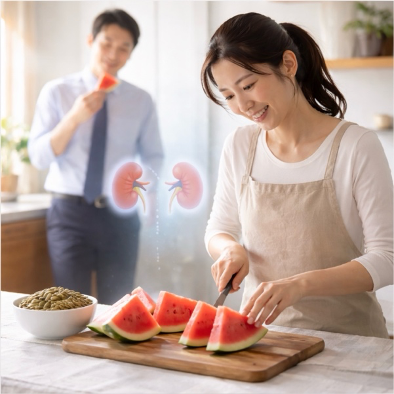 Amino acids — L-citrulline eNOS uses L-arginine as raw material. L-citrulline (from watermelon, pumpkin seeds) converts to arginine via the kidneys — more effective than arginine supplements taken directly. | PATHWAY 4  Nasal breathing — sinus reservoir The sinuses produce nitric oxide constantly. Nasal breathing draws it into the lungs, improving oxygen transfer into the blood. Mouth breathing bypasses this pathway almost entirely. |
THE MOUTHWASH FINDING Strong antiseptic mouthwash eliminates the oral bacteria that convert dietary nitrates into nitric oxide. Clinical trials found blood pressure rose measurably within 24 hours of use — and the effect persisted all week. The bacteria being killed are doing cardiovascular work. |
THE HUMMING FINDING Studies show humming increases nasal nitric oxide by up to 15 times compared to quiet breathing. The vibration moves the gas from the sinuses into the airway more efficiently. Ancient meditative practices involving sustained humming appear to have discovered this thousands of years before the biochemistry could explain it. |
The missing half:
NAD⁺ and where NMN fits in
Nitric oxide manages delivery — keeping circulation open so oxygen and nutrients reach their destinations. But once they arrive at the cell, something else converts them into usable energy. That something is NAD⁺ — nicotinamide adenine dinucleotide — essential for the mitochondria to function, for DNA repair to proceed, for the body’s cellular upkeep to continue. And like nitric oxide, it declines from your mid-thirties onward.
Nitric oxide Role Circulation & delivery Decline begins Mid-thirties Effect Fatigue, slow recovery | NAD⁺ Role Cellular energy & repair Decline begins Mid-thirties Effect Mitochondrial decline |
Nitric oxide gets resources to the cell. NAD⁺ determines what the cell does with them. Two systems, declining in parallel — neither sufficient without the other. |
NMN — nicotinamide mononucleotide — is a direct precursor to NAD⁺, found naturally in edamame, broccoli, and avocado. In randomised double-blind clinical trials, NMN supplementation has been shown to raise NAD⁺ levels, improve physical endurance, and slow biological age marker progression. A 2023 multicenter trial found biological age increased significantly in the placebo group over 60 days — while those taking NMN showed no significant change.
A NOTE FROM OKINAWA TA Medical is based in Okinawa — one of the world’s most studied examples of healthy longevity. The traditional lifestyle there supported all four nitric oxide pathways before anyone had names for them: daily movement, a diet rich in dark leafy greens, gentle oral habits, nasal breathing. Nobody was optimising their nitric oxide. They were simply living in a way that kept the underlying systems working. The research now explains why — and what it means for the rest of us. |
SOURCES & FURTHER READING Furchgott, Ignarro, Murad (1998). Nobel Prize in Physiology or Medicine — nitric oxide as a signalling molecule. Bryan, N.S., et al. (2012). Nitric oxide and geriatrics. Journal of Geriatric Cardiology. PMC3390088. Kapil, V., et al. (2013). Oral bacteria in blood pressure control. Free Radical Biology and Medicine. PMC3605573. Weitzberg & Lundberg (2002). Humming greatly increases nasal nitric oxide. Am J Respir Crit Care Med. PMID: 12119224. Yoshino, J., et al. (2018). NAD+ intermediates: NMN and NR. Cell Metabolism. PMID: 29514064. Yi, L., et al. (2023). Efficacy and safety of NMN supplementation. GeroScience. PMID: 36482258. For educational purposes only. Not medical advice. |
TA Medical · NMN Research Frontline · Research Information · Okinawa, Japan