The Resonating Walls: How Sound in Cathedrals Connects to the Human Body
How Helmholtz resonance shapes sound, breathing, and the body

TA Medical Research Team · 6 min read
Somewhere in northern France, in a medieval church whose name few people know, ceramic pots are embedded in the stone walls. They have been there for six hundred years.
The builders had no word for what they were doing. They had no instrument to measure it. They had only the experience of being inside a space where sound behaved differently — where the air itself seemed to participate in the chant.
The sense of calm, depth, or quiet clarity often described in such spaces does not arise from sound alone, but from the way low-frequency resonance interacts with the body. Subtle pressure changes and vibrations, amplified within the space, are transmitted through the chest and the bones of the skull, influencing breathing and autonomic nervous system activity.
Eight centuries later, the physics they were working with has a name. And it turns out to operate not only in stone walls — but inside the human skull as well.
01 The Resonating Walls of Medieval France
The ancient Roman architect Vitruvius described it in his treatise De Architectura, written two thousand years ago: bronze vessels, precisely tuned, placed in niches between theatre seats to shape the sound that passed through them. The Greeks called these vessels echea — literally, echoers.
The idea did not disappear. It resurfaced across medieval Europe and was embedded into the fabric of sacred buildings. Ceramic pots, functioning as resonant cavities, have been found in approximately 200 medieval churches — roughly half of them in France alone. They appear in vaults, walls, choir areas, and apses. They were placed not by acousticians but by monks and builders who recorded their purpose plainly in chronicles: to strengthen the voice and shape how it carried through the space.
 |  |
| CHRONICLE OF THE CÉLESTINS OF METZ — 1432 The prior, returning from a general chapter, ordered that pots should be placed into the choir of the church — having seen such in another church elsewhere, and believing that they made the singing better, and that the voice would resound more strongly. They were installed in a single day, with as many workers as were necessary. A later record from Saint-Denis-de-Vergy in 1616 documents payment for “three dozen small pots for placing in the wall of the choir, suitable for making the voice resonate.” |
What those medieval builders were constructing, without knowing the term, were Helmholtz resonators — enclosed cavities with a narrow opening that respond to specific acoustic frequencies, absorbing and re-emitting them in a way that shapes the character of the surrounding sound. The principle was formally described by the German physicist Hermann von Helmholtz in the nineteenth century. But the practice itself is far older. Wherever people gathered for sustained communal chanting — in theatres, in churches, in sacred spaces — builders found ways to tune the resonance of the environment to the human voice.
02 The Same Physics, Inside the Human Body
In 2002, researchers at the Karolinska Institute in Stockholm published a study in the American Journal of Respiratory and Critical Care Medicine with a finding that connected, across centuries, to those ceramic pots in French church walls. The experiment was simple. Healthy subjects hummed. And during humming, their nasal nitric oxide levels rose by 15 to 20 times compared to quiet breathing.
 | 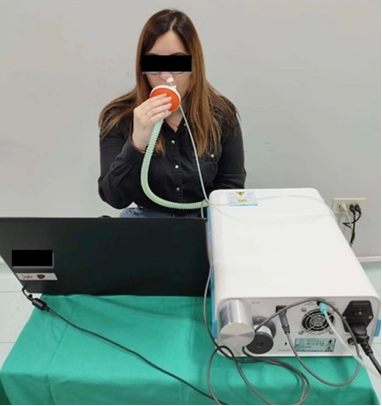 |
 Figure 1. Maniscalco M. et al. Assessment of nasal and sinus nitric oxide output using single-breath humming exhalations. European Respiratory Journal, 2003. https://publications.ersnet.org/content/erj/22/2/323 |
The explanation lies in the same principle. The paranasal sinuses — the hollow cavities behind the cheekbones, forehead, and nose — behave as resonant chambers. When we hum, sound vibrations create oscillating airflow through the narrow openings that connect the sinuses to the nasal cavity.
What connects these two systems is not symbolism, but mechanism.
A Helmholtz resonator does not simply “amplify sound” in the way a speaker does. It creates oscillations in pressure and airflow at specific frequencies. In a stone wall, this shapes how sound moves through space. In the human body, the same oscillation changes how air moves through the sinus openings.
The effect is physical. During humming, these oscillations increase the exchange of air between the sinuses and the nasal cavity. Nitric oxide, which is continuously produced and stored in high concentrations within the sinuses, is released into the airway in measurable surges.
In the cathedral, this resonance does not act on the ear alone. The experience often described in such spaces — a sense of calm, depth, or quiet clarity — does not arise from sound alone, but from the way low-frequency resonance interacts with the body. Sustained tones, amplified within the space, create subtle pressure changes and vibrations that are transmitted through the chest and the bones of the skull. This physical interaction can influence breathing patterns and autonomic nervous system activity, contributing to a state that is experienced as calm, balanced, and internally coherent.
| The medieval builders placed resonant cavities in their walls to shape the sound that moved through a sacred space. The human body places resonant cavities in the skull — and when sound moves through them, it releases a molecule that shapes the biology of the person producing it. The physics is identical. The scale is different. The principle has been present in both architecture and anatomy for a very long time. |
 |  |
The molecule released during this process is nitric oxide — and a Nobel Prize was awarded in 1998 for the discovery of what it does: it signals blood vessels to relax, keeps circulation flowing freely, supports the immune system, and helps deliver oxygen to every tissue in the body. The sinuses produce it continuously, and humming releases a surge of it directly into the airways with each breath.
But the sinuses are only one part of a larger system. Nitric oxide is also produced throughout the body’s blood vessels, where it helps regulate circulation over time. How that system is maintained — and how it connects to cellular energy processes — is something we return to shortly.
Research from the aquaphotomics laboratory at Yunosato in Wakayama suggests that audible sound can measurably reorganize the molecular structure of water. While the implications for human biology remain under investigation, it offers a thought-provoking perspective — particularly given that the human body is largely composed of water.

03 What the Builders May Have Known Without Knowing It
The connection does not require speculation. It can be traced through observation, accumulated over centuries and transmitted through practice rather than theory.
The people who built these resonant chambers, and those who gathered within them to chant, were responding to something real. Sustained, low-frequency vocalisation in a resonant space produces a physiological experience that differs measurably from speech or silence. The breath slows. The chest opens. The body settles.
Across cultures — in India, Tibet, Japan, and the Islamic world — similar practices emerged independently: sustained vocal resonance used not for performance, but for regulation of the body and mind.
“The acoustic pot is simultaneously an object useful for strengthening the voice in places whose sound quality is deemed unsatisfactory — and a medium symbolising the link between the temporal and the spiritual.” Valière et al. — Acta Acustica, 2013. Literary analysis of acoustic pots in French medieval churches |
What these builders and practitioners observed was not abstract. Low-frequency humming increases nasal nitric oxide. Nitric oxide dilates blood vessels, improves oxygen delivery, and supports immune function. The calm, the clarity, the sense of the body settling — these experiences have a physiological basis.
It would be an overreach to claim that medieval builders were intentionally optimising nitric oxide production. They were not. But it would be equally inaccurate to reduce their work to aesthetics alone. They were shaping physical environments that supported a particular state of the body.
04 The Complementary System —
A Brief Note on NAD⁺
Nitric oxide keeps the roads open—it relaxes blood vessels so oxygen and nutrients, including circulating precursors like NMN, can reach tissues efficiently. NAD⁺ determines what happens at the destination—it enables the cell to convert those resources into energy, carry out repairs, and maintain function. One manages delivery. The other determines what the cell does once it receives what it needs.
Neither works without the other. Both are supported by the same underlying conditions — regular movement such as daily walking, a balanced diet, and consistent nasal breathing.
Humming directly supports the sinus side of the nitric oxide system, producing an immediate effect. The rest of the system — vascular function, cellular energy, long-term resilience — develops more gradually, through how we live each day.
Nitric oxide Produced in the sinuses and blood vessel walls. Keeps circulation open and flexible. Supported by nasal breathing, movement, and diet. Temporarily amplified by humming via Helmholtz resonance. | NAD⁺ Essential fuel inside every cell. Powers mitochondrial energy and DNA repair. Supported by movement, diet, and NMN — a precursor found in foods such as edamame, broccoli, and avocado. |
Within the resonant spaces of medieval cathedrals, the architecture did not merely carry sound—it shaped it, reflecting and reinforcing low-frequency vibrations that could be physically felt in the body, while chanting and humming engaged the nasal passages, enhancing nitric oxide exchange in the airways and circulation. Together, the space and the voice formed a single acoustic system, influencing both the external environment and internal physiology.
For the monks in the choir, this was simply prayer—sustained, rhythmic, and communal. Yet within that practice, the body and the space were quietly aligned, the environment and physiology moving together as one.
THE DEEPER PATTERN The cathedral builders embedded resonance into the walls. The body contains resonance within the skull. In both cases, the structure shapes how sound moves — and in doing so, influences how the body responds. What was once observed through experience can now be described in measurable terms. Resonance alters airflow and vibration. Airflow alters gas exchange. Gas exchange alters physiology. The sense of calm and clarity people feel in these spaces comes directly from what is happening inside the body. |
05 A Practice as Old as the Body Itself
The Karolinska research showed that humming can dramatically increase nitric oxide release in the nasal passages, with measurements around ~130 Hz—a frequency typical of a relaxed, sustained hum—and broadly aligned with the natural resonant properties of the paranasal sinuses.
Similar low-frequency vocal practices appear across cultures: Tibetan throat singing, Gregorian chant, Vedic Om, and Japanese shōmyō. Each developed independently over centuries, yet all settled within a similar frequency range — not through measurement, but through repeated human experience of what works.
All of them were working with the same underlying principle.
Monks of Yakushiji Temple | A NOTE ON JAPANESE RESONANCE TRADITION The Buddhist practice of shōmyō — sustained, low-tone chanting — has existed in Japan since the 8th century. Temple architecture, like the great stone cathedrals of Europe, was designed to shape and carry sound. Chanting in such spaces produces a different physical experience from chanting in an ordinary room. The structure itself participates in the resonance. Whether the builders understood the biology is less important than what they achieved. Through architecture and voice, they created conditions that support a distinct state of the body and mind. |
06 Simple Practices —
Grounded in Old and New Science
– Hum briefly each dayA low, relaxed hum for 20–30 seconds, repeated a few times, activates the natural resonance of the sinuses and increases nitric oxide release. The tone should feel comfortable — lower frequencies tend to be more effective.
– Breathe through the nose by defaultNasal breathing delivers nitric oxide directly into the airways. Mouth breathing bypasses this system entirely. During rest and light activity, nasal breathing helps maintain a steady baseline.
– Understand the time scaleThe nitric oxide released during humming is immediate but short-lived. The broader system — vascular health and cellular function — develops over time through consistent daily habits.
– Use your environmentSpaces that reflect and carry sound — such as tiled rooms, wooden interiors, or large enclosed spaces — enhance resonance. The body responds not only to what you do, but to the environment you do it in.
– Support the system as a wholeNitric oxide supports circulation. NAD⁺ supports cellular energy. Addressing both — through breathing, movement, and nutrition — works with the body as an integrated system.
KEY RESEARCH REFERENCES Weitzberg E. & Lundberg J.O. (2002). Humming greatly increases nasal nitric oxide. American Journal of Respiratory and Critical Care Medicine, 166, 144–145. pubmed.ncbi.nlm.nih.gov/12119224 Maniscalco M. et al. (2003). Assessment of nasal and sinus nitric oxide output using single-breath humming exhalations. European Respiratory Journal, 22, 323–329. pubmed.ncbi.nlm.nih.gov/12952268 Valière J.C. et al. (2013). Acoustic pots in ancient and medieval buildings: literary analysis of ancient texts and comparison with recent observations in French churches. Acta Acustica, 99. Kanev N. (2020). Resonant vessels in Russian churches and their study in a concert hall. Acoustics, 2(2). doi.org/10.3390/acoustics2020023 Phua T.J. (2024). Hallmarks of aging: hypovascularity, tissue perfusion and nitric oxide perspective on healthspan. Frontiers in Aging. doi.org/10.3389/fragi.2024.1526230 This article is for educational and informational purposes only. It is not intended as medical advice. Please consult a healthcare professional for personal health decisions.
TA Medical · NMN Research Frontline · Research Information Media |