How Biological Age is Measured — Not by How you Look or How you Feel, but by Scientific Evidence
Updated: Apr 30
TA Medical Research Team · 6 min read · Health-span & Science

Kenji and Hiroshi are identical twins. Both are 50 years old.
They share the same DNA — but live very different lives in Okinawa.
One has the cardiovascular function of someone in their early forties —flexible arteries, efficient mitochondria, cellular repair systems at near full capacity.
The other has the biological markers of someone approaching their mid-sixties.
Their birth certificates are identical. Their bodies are a decade apart.
This gap is more common than it seems. People of the same age are often not the same age biologically. For most of history, medicine could observe this difference through appearance and reported symptoms — but not measure it.
Today, that has changed. We can now measure how old your body actually is—and these tools are widely accessible. Your birthday counts each trip around the sun. Biological age tells you how your body is aging at the cellular level.
01 Why Chronological Age Tells
Only Half the Story
Age, as we usually measure it, is simply a count. The number of times the Earth has circled the sun since you were born. It is precise and universal—but it tells you little about how healthy you actually are. Medicine has known for decades that two people of identical age can be in completely different states of health. What it lacked was a way to measure that difference directly.
That changed when researchers discovered that aging leaves physical marks on DNA. Not in the genetic code itself — your genes do not change — but in the layer of chemical signals that sit on top of it, controlling which genes are active and which are silent. These signals shift over time in patterns that are predictable, measurable, and respond to how you live. Scientists learned to read those patterns like a clock.
The result is biological age — a number that reflects not how many years you have lived, but how much your body has actually changed. It responds to what you eat, how you sleep, how much you move, and how much stress your body carries.
Dr. Steve Horvath laid the scientific foundation for measuring this in 2013. The tools to do it outside a research laboratory have arrived only recently.

10+ Years of biological age difference can exist between people of the same chronological age | 900k+ Advanced tests read over 900,000 points in your DNA to calculate biological age | 45+ Validated by over 45 independent research teams worldwide |
02 The Science Behind the Clocks — What Each One Actually Measures
Not all biological age tests measure the same thing. Some tell you where you are. Others tell you where you are heading — and how fast. Knowing which type of test you are looking at makes all the difference in how useful the result actually is.
Horvath Clock First Generation · 2013  | Developed by Steve Horvath at UCLA, this method showed that aging leaves a measurable pattern on DNA through methylation — small chemical markers that shift over time. By analysing these patterns across many sites, it can estimate biological age from a single sample with high accuracy. It marked a shift from observing aging externally to measuring it at the molecular level, but was designed as a reference tool rather than to track short-term lifestyle changes. Best for: your first biological age baseline. |
PhenoAge Second Generation · 2018  | Dr. Morgan Levine at Yale took a different approach. Instead of predicting how old you are, her clock uses routine blood test markers to estimate how well your body is functioning—and your risk of age-related disease. Two people can have the same biological age on this scale and very different health outlooks. Best for: understanding your risk of age-related disease. |
GrimAge Second Generation · 2019  | Where other clocks estimate how old your body is, GrimAge asks a harder question: how long does it have? It was built from data tracking people over many years — right up until the end of their lives. A 2025 study by the US National Institute on Aging confirmed it outperforms every other clock when it comes to predicting lifespan. A sobering number to receive, but for many people, a genuinely useful one. Best for: understanding your long-term longevity risk. |
The three most established approaches each answer a different question:
· Horvath Clock → What is my biological age right now?
· PhenoAge and GrimAge → What does my biological age suggest about risk?
· DunedinPACE → How fast am I ageing at this moment — and is that changing?
The first two are valuable for establishing where you stand. What they cannot do reliably is detect whether a specific change — in diet, exercise, sleep, or supplementation — is actually shifting your biological age in real time.
The newer approach, DunedinPACE was developed specifically to answer that question.
THE PACE CLOCK — DunedinPACE Rather than giving you an age number, DunedinPACE measures the speed at which you are currently ageing. A score of 1.0 means ageing at an average rate. Below 1.0 means slower. Above 1.0 means faster. Built from decades of tracking the same group of people over their lifetimes at Duke University and the University of Otago, it is sensitive enough to detect changes from diet, exercise, sleep, and supplementation within just a few months. A major two-year study — the CALERIE trial — confirmed this: DunedinPACE detected a meaningful slowing in the pace of ageing in participants who made changes, while the Horvath Clock and PhenoAge registered no shift at all. If you want to know whether what you are doing is actually working inside your body, this is currently the most sensitive tool available for that answer. |
A major two-year study on caloric restriction — known as the CALERIE trial — found that DunedinPACE detected a meaningful slowing in the pace of ageing in the group that made changes, while the Horvath Clock and PhenoAge failed to register the same shift.
If you want to know whether what you’re doing is working inside your body, DunedinPACE is currently the most sensitive tool available.
03 Current Testing Options —
What Is Available and What It Offers
There are now several ways to test your biological age, ranging from mail-in kits you can do at home to comprehensive panels ordered through a clinic. The options below are among the most credible currently available — each one backed by published research rather than marketing claims alone.
TruDiagnostic TruAge Blood · DunedinPACE + GrimAge + SYMPHONYAge One of the most comprehensive biological age tests currently available to the public. A single finger-prick blood sample is analysed across over 900,000 points in your DNA — giving you three distinct readings: how fast you are ageing right now, your long-term longevity risk, and separate biological age scores for eleven organ systems including the brain, heart, and immune system. More than 45 independent research teams have published studies validating its methodology. Among longevity researchers, it is widely regarded as the benchmark for consumer biological age testing. |
Elysium Index Saliva · APEX Algorithm + System Ages Developed with Dr. Morgan Levine of Yale — the scientist behind PhenoAge — this test works from a saliva sample rather than blood, making it the more convenient option for those who prefer to avoid a finger prick. It gives you an overall biological age, your current pace of ageing, and separate scores for nine body systems. Elysium designed their analysis platform specifically to reduce the inconsistency that saliva samples typically introduce, bringing the margin of variation down to roughly one year — comparable to blood-based tests in terms of reliability. |
NOVOS Age Blood · DunedinPACE + Telomere Estimate + Organ Clocks Covers similar ground to TruDiagnostic but at a more accessible price. A blood sample is analysed across over 850,000 points in your DNA, giving you four readings: your overall biological age, organ-specific ages, your current pace of ageing, and an estimate of your telomere length — the protective caps on your chromosomes that shorten with age. A solid option for anyone wanting comprehensive coverage without the premium price tag. |
GlycanAge Blood · IgG Glycome Analysis GlycanAge takes a completely different approach to the others. Rather than reading your DNA, it analyses a blood sample to measure changes in your immune system — specifically in the sugar molecules attached to your antibodies, which shift in measurable ways as the body ages and accumulates inflammation. It is backed by over twenty years of dedicated research and dozens of published studies. Where the DNA-based tests give you a broad picture of biological age, GlycanAge is particularly good at revealing the inflammatory side of ageing — the slow, silent kind that builds up over years and is highly responsive to changes in diet, movement, and lifestyle. |
Clinic-Based Testing Physician-Ordered · Full Panel Some longevity clinics and integrative medicine practices now offer biological age testing as part of a full health assessment. These panels combine epigenetic clock testing with direct blood measurements — NAD⁺ levels, inflammatory markers, metabolic indicators, and telomere length — all interpreted by a physician. This is the key advantage. A number without context has limited value. A physician can tell you what is driving it and what to do about it. |
04 A note for athletes — why biological age testing matters for peak performance
Biological age testing isn’t just for those thinking about long-term health. For athletes — competitive or recreational — it’s a way to maintain peak performance by tracking how well training, recovery, and nutrition are working at the cellular level, not just on the scoreboard.

For an athlete in their twenties or thirties, the most relevant question is not how old am I biologically? but how fast am I ageing — and is my recovery keeping pace with my training load? This is precisely what DunedinPACE was designed to measure. A pace score above 1.0 in a young athlete can indicate that training stress is outpacing cellular recovery — a warning sign that rarely shows up in standard fitness tests until performance has already declined.
GlycanAge is particularly informative for athletes because it measures the inflammatory side of ageing — chronic, low-grade inflammation that accumulates silently from overtraining, poor diet, or inadequate sleep. Many athletes carry significantly higher inflammatory markers than expected for their age, and GlycanAge can make that visible before it becomes a problem.
Approximate cost in Japanese yen:
Test | Sample | Approx. Cost |
TruDiagnostic TruAge | Blood | ¥75,000 |
Elysium Index | Saliva | ¥75,000 |
NOVOS Age | Blood | ¥52,000 |
GlycanAge | Blood | ¥52,000 |
For athletes testing every six months to track the impact of a training cycle, the most practical starting point is NOVOS Age or GlycanAge — both provide the DunedinPACE pace score or inflammatory markers most relevant to athletic performance, at the more accessible price point. For a comprehensive baseline, TruDiagnostic TruAge remains the most detailed option available.
05 How Testing Works —
From Sample to Result
The process is simpler than it sounds. Every cell in your body carries the same DNA, so a small blood or saliva sample is all that’s needed. The lab then looks at tiny chemical markers on your DNA — called methylation — across hundreds of thousands of points. These patterns are analysed using a scientifically tested model — often called a “clock” — which estimates your biological age, or how quickly your body is aging.
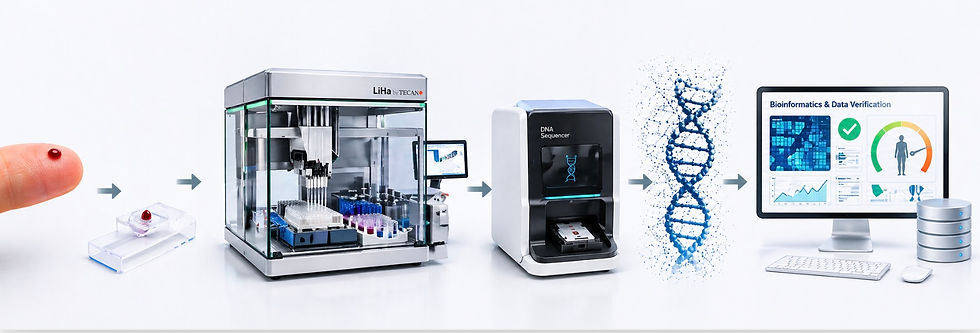
These tests do not read a single DNA molecule. They extract DNA from thousands of cells in your sample, analyse all of them, and calculate an average pattern across the whole group. The more uniform those cells are, the more reliable the result. Blood is a clean, consistent source — you get the same type of cells every time. Saliva contains a shifting mix of cells, bacteria, and other material that changes with every sample, diluting the average and introducing noise. The same person tested twice from saliva can see results differ by several years, even though nothing has changed. Blood-based testing brings that variation down to roughly one year — which matters if you are trying to track whether something is actually working.
Turnaround time: Most at-home kits follow the same basic process — you receive a collection kit, provide your sample, seal it and send it to the laboratory, and receive your results online, typically within four to six weeks. One test gives you a starting point. Testing every six to twelve months shows you which direction you are moving — and whether what you are doing is working. |
06 What the Numbers Actually Mean — and What They Don’t
A biological age result is a snapshot, not a verdict. It reflects the combined effect of how you live — your diet, training, recovery, sleep, stress, and environment — up to the moment the sample was taken.
For athletes, this goes beyond performance on the field or in the gym. It shows whether your current routine is supporting long-term resilience and efficient recovery at the cellular level.
It does not predict a fixed outcome. It shows your current trajectory.
This distinction matters. A biological age higher than your actual age is not a sentence — it’s feedback. It tells you that your current approach is placing a measurable load on your system.
If unchanged, that trajectory continues. If adjusted, it can shift.
The same measurement taken months after refining training, nutrition, and recovery can tell a very different story.

A NOTE ON REALISTIC EXPECTATIONS A biological age result can feel definitive — but it isn’t. It reflects patterns, not predictions. Which means a result a few years higher or lower than your actual age is often within normal variation. What matters is not the number itself. It’s what happens to it next. One test is a snapshot. Repeated over time, it becomes something far more useful — a way to see whether the way you live is moving you in the right direction. |
07 Where NAD⁺ Fits Into This Picture
NAD⁺ sits at the centre of biological aging — not at the edges of it. Every cell in your body depends on it to produce energy and repair DNA damage. But its most important role is powering a family of proteins called sirtuins — seven of them in total, known as SIRT1 through SIRT7. Think of sirtuins as your body's cellular maintenance team. They regulate which genes are switched on or off, repair damage to DNA, and maintain the methylation patterns that biological age tests directly measure.
When NAD⁺ is abundant, this system runs efficiently. As it declines—measurably from the mid-thirties onward—sirtuin activity slows, DNA repair becomes less effective, and methylation patterns begin to shift toward accelerated aging.
This is the core mechanism epigenetic clocks measure — and it directly shapes how well the body performs, recovers, and, in athletes, sustains peak condition.

NMN is one of the most direct ways to restore NAD⁺ levels. In a 2023 randomised, double-blind, placebo-controlled trial (GeroScience), the placebo group showed an increase in biological age, whereas the NMN group maintained stable levels.
Measuring your biological age before and after NMN supplementation—alongside improvements in diet, exercise, and sleep—provides objective insight into whether the approach is working within your own body.
HOW TO APPROACH BIOLOGICAL AGE TESTING SENSIBLY
What biological age testing offers is not a definitive answer, but a way to see more clearly where your body stands right now. How your daily habits—your diet, training, and recovery—are actually showing up beneath the surface. Over time, that insight becomes less about a single number, and more about how well you are sustaining your healthspan. It may not be a small cost. But viewed over time, it becomes something closer to an investment in maintaining resilience and managing long-term risk—helping you identify changes sooner and adjust your habits before they become more difficult to reverse—addressing imbalance before it becomes disease. That alone may be reason enough to take a closer look. |
KEY RESEARCH REFERENCES Horvath S. (2013). DNA methylation age of human tissues and cell types. Genome Biology, 14, R115. doi.org/10.1186/gb-2013-14-10-r115 Levine M.E. et al. (2018). An epigenetic biomarker of aging for lifespan and healthspan. Aging (Albany NY), 10, 573–591. doi.org/10.18632/aging.101414 Lu A.T. et al. (2019). DNA methylation GrimAge strongly predicts lifespan and healthspan. Aging (Albany NY), 11, 303–327. doi.org/10.18632/aging.101684 Belsky D.W. et al. (2022). DunedinPACE, a DNA methylation biomarker of the pace of aging. eLife, 11, e73420. doi.org/10.7554/eLife.73420 Waziry R. et al. (2023). Effect of caloric restriction on biological aging in healthy individuals — CALERIE Trial. Nature Aging. doi.org/10.1038/s43587-022-00357-y Yi L. et al. (2023). The efficacy and safety of β-NMN supplementation in healthy middle-aged adults: a randomized, multicenter, double-blind, placebo-controlled trial. GeroScience, 45, 29–43. doi.org/10.1007/s11357-022-00705-1 Beydoun M.A. et al. (2025). GrimAge epigenetic clock outperforms other aging clocks in mortality prediction. Aging Cell. doi.org/10.1111/acel.14462 Teschendorff A.E. & Horvath S. (2025). Epigenetic ageing clocks: statistical methods and emerging computational challenges. Nature Reviews Genetics, 26, 350–368. This article is for educational and informational purposes only. It is not intended as medical advice. Biological age tests are not medical diagnostic devices and do not diagnose, treat, or prevent any disease. Please consult a healthcare professional for personal health decisions.
TA Medical · NMN Research Frontline · Research Information Media |