The Chair, the Floor, and the Biology of Ageing Well
What the world’s longest-lived populations share goes deeper than diet or exercise. It points to the biology of how cells maintain themselves — and how that process is supported.
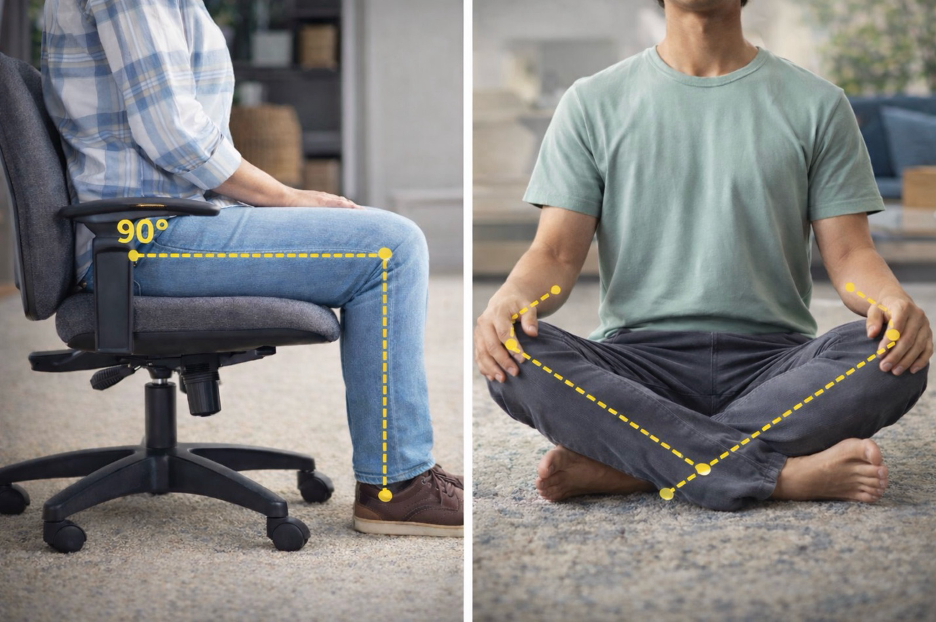
Your hips are probably at 90° right now. They were at 90° for most of your waking hours yesterday, and the day before — at breakfast, in the car, at your desk, at dinner. The position feels neutral. It is not. It carries a cost — not felt as discomfort, but reflected in tissue that has quietly remodelled around it over decades.

01
Five Cultures. Five Continents. No Chairs.
Dan Buettner spent years documenting the five Blue Zone populations — the places on Earth with the highest concentrations of centenarians. He found the expected factors: plant-heavy diets, strong social bonds, a sense of purpose, and moderate daily activity. He also identified something the medical establishment had largely overlooked.

The longest-lived populations on Earth do not rely on chairs. They sit on or near the ground — on tatami mats, low wooden stools, stone benches, hammocks, and floor cushions — and they get up from the ground dozens of times a day, throughout their lives.
Okinawa Tatami mats on the floor | Sardinia Low stools & stone benches | Ikaria Low chairs & ground-level living | Nicoya Hammocks & low platforms | Loma Linda Floor cushions & ground-level living |
Five geographies, five different diets, five genetic backgrounds, five climates. One shared detail that longevity research has largely overlooked: the consistent absence of the chair. That might be coincidence. The biomechanics suggests it is not.
02
What the Chair Eliminated —
and Why It Matters
A standard chair places the hips and knees at approximately 90° of flexion. One position. One configuration of the musculoskeletal system, held for hours, repeated daily, across decades.
Floor sitting moves the body through multiple configurations. Biomechanist Katy Bowman has noted that it exposes the hip joint to approximately 30 distinct positional variations — many of which chair sitting eliminates entirely. Thirty versus one.
The body does not lose range of motion from aging. It loses it from not using it.
The chair holds the primary hip flexor — a deep muscle connecting the spine to the thigh — in a shortened state for hours at a time, day after day. Over years, the muscle remodels to that shorter length.
When a person stands, it pulls the lower spine into a subtle forward tilt — compressing the joints of the lower back and forcing surrounding muscles to compensate.
The lower back pain that millions attribute to aging often originates, in significant part, from a muscle the chair has kept short.
03
Cartilage Has No Blood Supply —
It Eats Through Movement
Most people are never told this: articular cartilage — the smooth tissue covering the ends of bones within joints — has no blood supply. None. It receives nutrients through diffusion from synovial fluid, driven by mechanical loading and unloading.
When the joint is compressed, fluid is squeezed out. When the pressure is released, fluid is drawn back in, carrying oxygen, glucose, and the building blocks chondrocytes need to maintain cartilage structure.
This mechanism is called imbibition — the sole way cartilage remains viable.

A hip joint held at 90° loads the same surfaces continuously, squeezing fluid out and preventing its return. The surfaces the chair neglects receive no imbibition — and no nutrition.
The osteoarthritis that develops in those areas is not the result of wear and tear. It is the result of absent movement.
What is often described as wear and tear is, more accurately, nutrient deprivation — a joint surface that was never given the movement it needed to stay nourished.
THE CORE FINDING The ability to move from sitting on the floor to standing is strongly linked to long-term health outcomes — and practising that movement can help improve them. Blood pressure can predict health risk, but measuring it does not change it. Movement is different: the action itself is the stimulus. The movement is the medicine. |
04
The Direction Reverses —
If You Give the Body a New Signal
Tissue remodels in both directions. Muscles lengthen when maintained at longer lengths. Sarcomeres are added in series — the inverse of the shortening the chair produced.
Motor patterns for deep squatting can be relearned because they were never genetically lost — only suppressed through decades of non-use.
Araújo’s subsequent work confirmed that subjects who began practising floor transitions showed measurable improvements in their composite sitting-rising scores over months. Each one-point improvement corresponds to a 21% reduction in mortality risk.
The capacity the test measures is not fixed. It responds to the stimulus of the movement itself.
The process is gradual, and the starting point matters less than the direction. Studies of progressive floor sitting in older adults consistently show measurable improvement — at any age, from any baseline.

Start with support nearby — a chair or wall within reach while practising lowering to the floor and rising from it. Reduce support progressively as capacity improves.
Introduce floor time gradually — begin with a cushion to reduce hip flexion demands. Lower the cushion height as tissues adapt over time.
Vary positions — cross-legged, kneeling, side-sitting. Each loads different joint surfaces and stretches different muscle groups. Variety is the mechanism.
Work toward the deep squat — heels flat, hips below the knees. This is not an exercise. It is a resting position the human body was designed to use — one that every healthy toddler adopts naturally.
Be patient with the timeline — measurable flexibility gains take weeks to months; full restoration of movement patterns may take longer. The direction is consistent. The body responds to the signal it has been waiting for.
05
The Deeper Pattern Behind the Movement
There is a biological reason why Blue Zone populations age so differently — and it runs deeper than diet or social connection. Every transition from floor to standing activates the mitochondria, stimulates NAD⁺ production, and signals the body’s cellular repair systems to remain active.
These are not separate benefits. They are part of a single mechanism that modern longevity research now identifies as central to maintaining healthspan — the quality and capability of life, not simply its length.
The longest-lived people on Earth were not trying to live longer. They were simply living well — moving through their full range, dozens of times a day, throughout life. Their bodies remained functional, resilient, and capable well into their later decades.
The science behind why this works is something we are only now beginning to fully understand.
SOURCES & FURTHER READING Araújo C.G. et al. (2012). Ability to sit and rise from the floor as a predictor of all-cause mortality. European Journal of Preventive Cardiology. Clinimex, Rio de Janeiro. Bowman K. (2010s). Movement variability and floor sitting biomechanics. Nutritious Movement research and publications. Kasuyama T. et al. Floor sitting habits and mobility in aging populations. Journal of Physiological Anthropology. Buettner D. (2008). Blue Zones: Lessons for Living Longer from the People Who Have Lived the Longest. National Geographic Society. This article is for educational and informational purposes only. It is not intended as medical advice. If you have existing joint conditions or mobility concerns, please consult a healthcare professional before making changes to your movement habits. TA Medical · NMN Research Frontline · Research Information Media |