How Much NMN Can You Get from Food? Food vs Supplements and Their Effects on NAD⁺ Levels
- Mar 21
- 4 min read
Updated: Mar 24
NMN exists in foods — but are the amounts enough to support NAD+ levels as you age?
Getting NMN from Food: Why It’s Only the First Step

If you've been curious about NMN, chances are you've wondered: do I really need a supplement, or can I just eat the right foods? It's a great question — and the answer is actually a little of both.
Yes, NMN exists naturally in everyday foods you probably already enjoy. But there's a catch. Let's walk through what the science says, which foods top the list, and what it all means for your health.
First, What Exactly Is NMN?
NMN stands for Nicotinamide Mononucleotide. It's a naturally occurring molecule found in all living cells — including yours. Your body uses NMN to produce NAD+ (Nicotinamide Adenine Dinucleotide), a vital coenzyme that powers hundreds of biological processes.
Think of NAD+ as the fuel your cells run on. It helps with energy production, DNA repair, metabolism, and keeping your body's internal clock ticking properly. The problem? NAD+ levels drop significantly as we age — and with it, cellular energy and repair slow down too.
This is why researchers around the world have become so interested in NMN: as a direct building block of NAD+, it offers a way to replenish these declining levels.
So, Which Foods Contain NMN?
Good news — NMN is found in a variety of foods that are easy to include in a regular diet. The data below comes from a landmark 2016 study published in the journal Cell Metabolism by researchers at Washington University School of Medicine, which measured NMN content across a range of common foods.
Here's how they stack up, per 100g (roughly a small handful or portion):

Source: Mills et al. (2016), Cell Metabolism. Values represent measured ranges across different samples.
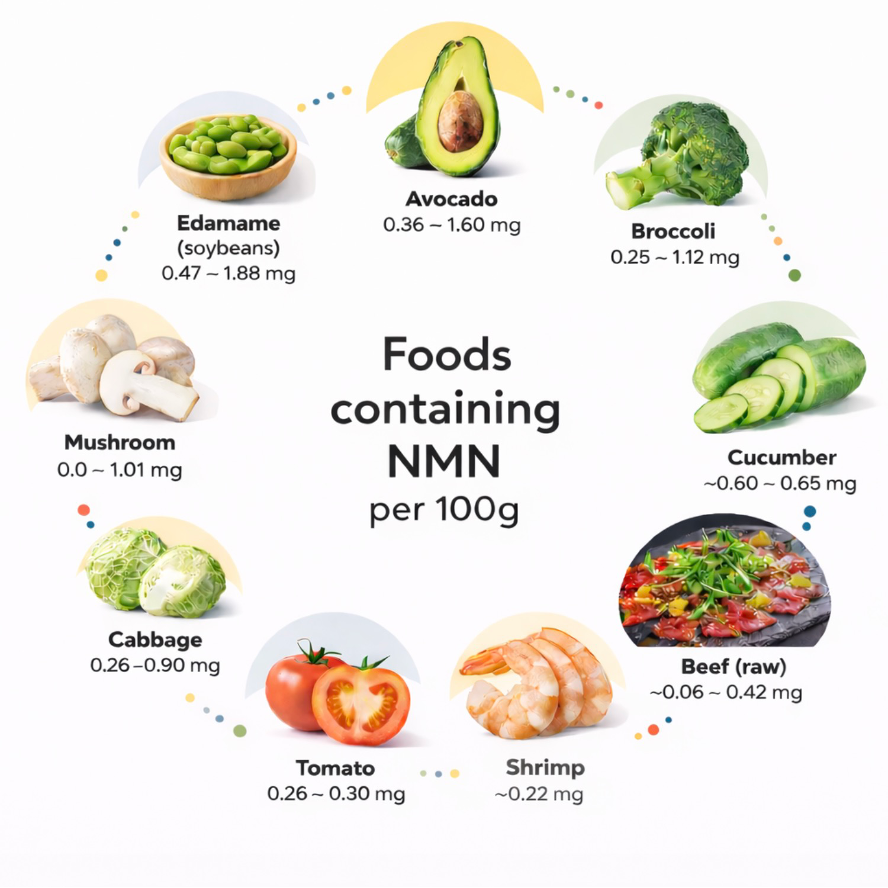

Foods contain less than ~1 mg of NMN per 100 g, while a single supplement tablet provides 125 mg. This highlights how difficult it would be to obtain meaningful amounts of NMN from diet alone. |
The Reality Check: How Much Would You Need to Eat?
Here's where things get interesting. While it's wonderful that NMN appears in these wholesome foods, the amounts are quite small — and the gap between what food provides and what research suggests is meaningful is very large.
Current human clinical studies have typically used NMN doses ranging from 250mg to 500mg per day. To put that in perspective using food alone:

How Much Food Would You Need? To reach just 250mg of NMN from food, you would need to eat approximately: • Edamame: around 13,000–25,000 beans • Broccoli: roughly 500–1,000 heads • Avocado: approximately 150–700 avocados Every single day. That's simply not realistic. |
This isn't meant to discourage you from eating broccoli or edamame — quite the opposite. These are incredibly nutritious foods with many benefits beyond NMN. But it does put things in perspective: eating NMN-rich foods supports your body's natural baseline, but it cannot realistically replace the concentrated amounts that researchers are studying.
Does Cooking Affect NMN in Food?
Yes — and this is worth knowing. NMN is a heat-sensitive compound, which means cooking methods do affect how much survives to your plate.
Here are some simple tips to get the most out of NMN-containing foods:
Eat edamame lightly steamed or as-is — avoid boiling for long periods
Enjoy cucumber, tomato, and avocado raw whenever possible
Steam broccoli briefly (2–3 minutes) rather than boiling it
Freshness matters — NMN degrades over time, so fresher is better
Why Does NAD+ Decline With Age?
Your body naturally produces NMN on its own — and uses it to keep NAD+ levels stable. When you're young, this system works efficiently. But from around your 30s onward, two things happen:
Your body's ability to produce NMN internally starts to slow down
The enzymes that convert NMN to NAD+ become less active
The result is a steady, measurable decline in NAD+ levels as you age. Research has linked lower NAD+ to reduced energy, slower metabolism, impaired DNA repair, and other hallmarks of the aging process. Diet helps maintain your baseline, but it cannot fully compensate for this natural decline.
Food as a Foundation, Not a Ceiling
The best way to think about NMN-rich foods is as a healthy foundation — not a complete solution on its own.
Including edamame, avocado, broccoli, cucumber, and tomato in your regular meals is genuinely beneficial. These foods provide small but steady amounts of NMN that help support your body's natural production. They also come packed with fiber, vitamins, antioxidants, and other compounds that work together for overall health.
But if your goal is to meaningfully boost NAD+ levels — as studied in research on energy, metabolism, and healthy aging — food alone cannot bridge that gap. That's where high-quality NMN supplementation comes in: it delivers a consistent, concentrated dose that works alongside a healthy diet, not instead of one.
What to Look For in an NMN Supplement
Not all NMN supplements are created equal. If you're considering adding one to your routine, here are the key things to look for:
Purity: high-quality NMN should be tested for purity and free from unnecessary additives
β-NMN form: this is the biologically active form your body uses naturally
Manufacturing transparency: look for brands that share their production process & quality testing
Appropriate dosage: most research has used between 250mg–500mg daily
At TA Medical, NMN is both our specialty and our passion. As a dedicated NMN raw material provider with our own supplement line, we hold ourselves to the same rigorous research standards we follow in all our formulations.
TA Medical — NMN Food & Intake This article is for general informational purposes and is not intended as medical advice. If you have specific health concerns, please consult a healthcare professional. |