Are you choosing supplements based only on label impressions?
Updated: May 25
How accredited laboratories verify NMN — what they check, what instruments they use, and why it matters more than anything on the label.
TA Medical Research Team · Quality & Safety Series · 6 min read

Independent analyses of commercially sold NMN supplements have revealed major discrepancies between label claims and actual contents — including products that contained only trace levels of NMN, despite being marketed as high-potency formulations.
These were not fringe products from unknown brands. They were bestsellers — products with professional packaging, confident claims, and thousands of positive reviews. The labels looked credible. The contents were not.
The supplement market operates largely on trust, because most countries do not require independent pre-market testing before a product goes on sale. A manufacturer can print almost any number on a label. Without accredited third-party verification, the consumer has no reliable way to confirm it.
There is one more assumption worth addressing before going further. A high price does not indicate rigorous testing. It indicates a high price. In the supplement market, expensive packaging and high pricing often create an impression of scientific credibility and superior quality that may or may not reflect the level of actual verification behind the product. The price on a label and the certifications on a package are different kinds of information, and only one can be traced back to accredited analytical testing and traceability records.
This article explains what rigorous independent verification actually looks like — the institutions that conduct it, the instruments they use, and what each test is specifically designed to find. Understanding this makes it considerably easier to tell the difference between a supplement that has been genuinely verified and one that simply says it has.
01 The Accredited Institutions and
What They Check
The most thorough verification programs combine several accredited institutions — each one examining a different stage of the product’s journey, from raw ingredient to finished lot.
Accredited Institution | What They Verify | Scientific Methods Used |
Japan Food Research Laboratories (JFRL) | NMN purity, molecular identity, heavy metals, contaminants, microbiological safety, stability | HPLC, LC/MS, GC/MS, ICP/MS, NMR, IR spectroscopy, endotoxin and microbial testing |
Japan Food Inspection Corporation (JFIC) | Food safety, heavy metals, pesticides, microbiological contamination, regulatory compliance | ICP-MS, LC-MS/MS, GC-MS, microbial assays, food safety analytical systems |
LGC Group — Two certifications, issued by the same organisation, covering different stages | ||
LGC Informed Ingredient | Raw ingredient verification — prohibited substance screening and supply chain traceability before production begins | LC-MS/MS, GC-MS/MS, 250+ prohibited substance screening at the raw material stage |
LGC Informed Sport | WADA banned substance verification on every individual production lot before consumer release | LC-MS/MS ultra-trace analysis, lot-by-lot mass spectrometry screening |
ISO/IEC 17025 Accredited Laboratories | Laboratory competence, instrument calibration, method validation and result traceability | International analytical standards, traceable calibration protocols, independently audited methods |
Each of these institutions operates independently of the manufacturers whose products they test. Their equipment is calibrated to international standards, their methods validated and documented, and their results externally auditable. A certification from one of these bodies is a documented result — one that can be verified, and in cases of non-compliance, revoked.
02 What the Scientific Instruments
Actually Do
The methods listed above are often presented as acronyms without explanation. Each one is a specific analytical instrument designed to answer a specific question about what is present in a substance. Each number on a genuine Certificate of Analysis was produced by one of these instruments, in an accredited laboratory, not a manufacturer’s own facility.
Scientific Method | What It Actually Does |
HPLC | Measures how much real NMN is actually present — the precise quantity confirmed by instrument, not stated by the manufacturer |
NMR | Confirms the molecule is truly β-NMN, the biologically active form. NMN also exists as α-NMN, a structurally similar variant the body cannot use — NMR is what distinguishes one from the other |
ICP-MS | Detects toxic heavy metals — lead, arsenic, mercury, cadmium — at concentrations as small as one part per trillion |
GC-MS | Checks whether residual chemical solvents remain from the manufacturing process — invisible to the eye, detectable by instrument |
LC-MS/MS | The most sensitive method in routine use. Detects ultra-trace contaminants and banned substances at parts-per-billion levels or lower |
IR Spectroscopy | Produces a molecular fingerprint confirming the structural identity and integrity of the compound |
Microbial Testing | Checks for bacteria, mould, yeast, and other biological contamination that standard chemical analysis cannot detect |
Endotoxin Testing | Detects bacterial toxins that can cause inflammation even when the bacteria themselves are no longer present in the product |
03 The Instruments in the Laboratory
The following images show the actual analytical instruments used in accredited NMN testing. Each plays a distinct role in the verification process.
 HPLC Machine High-Performance Liquid Chromatography. The sample is dissolved in solvent and pushed through a tightly packed column under high pressure. Different compounds travel at different speeds, separating from each other. A detector measures each as it exits, producing a precise graph of what is present and in what quantity. Used to confirm NMN concentration and purity.  |
 NMR Spectrometer Nuclear Magnetic Resonance Spectrometer. The sample is placed in a powerful magnetic field. Atomic nuclei absorb and re-emit radio frequency energy in patterns unique to each molecular structure, producing a detailed molecular fingerprint. Confirms not just that NMN is present, but that it is the biologically active β-NMN form — not α-NMN, a structurally similar variant the body cannot utilise.  |
 ICP-MS Instrument Inductively Coupled Plasma Mass Spectrometry. The sample is vaporised in a plasma torch at approximately 8,000°C, converting all elements into ions. These are then sorted and counted by mass. Detects toxic heavy metals — lead, arsenic, mercury, cadmium — at concentrations as low as one part per trillion. The standard tool for heavy metal safety testing in food and supplement analysis.  |
 GC-MS System Gas Chromatography–Mass Spectrometry. The sample is vaporised and carried through a column by an inert gas. Compounds separate by boiling point and chemical affinity, then each is identified by molecular weight as it exits. Used in NMN testing to detect residual manufacturing solvents that would be invisible to any other means of inspection.  |
 LC-MS/MS System Liquid Chromatography–Tandem Mass Spectrometry. The most sensitive analytical method in routine use. The sample is separated by liquid chromatography, then passed through two sequential mass spectrometers — the first isolates a target compound, the second confirms its identity by fragmentation. Eliminates false positives. Used for prohibited substance screening and ultra-trace contaminant analysis at parts-per-billion levels or lower. 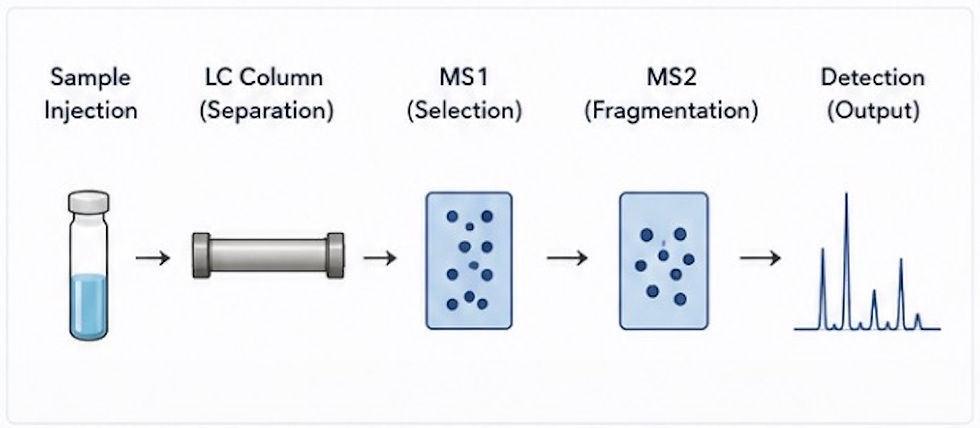 |
04 Verification at Multiple Stages
By the time a finished capsule is tested, most of what determines its quality has already happened upstream. A contaminant introduced at the raw material stage can survive the manufacturing process and appear in the finished product.
This is why LGC operates two complementary certification systems that verify supplements at different stages of production.
LGC Informed Ingredient certification focuses on the raw material stage — before an ingredient enters manufacturing. It requires testing for more than 250 prohibited substances together with full supply chain traceability documentation. The goal is to identify potential problems before production even begins.
LGC Informed Sport certification focuses on the finished product stage. Every individual production lot intended for consumer release is independently tested for WADA prohibited substances before reaching the market. Not annually. Not periodically. Every lot, every time.
Together, these two systems address different points of risk within the manufacturing chain: one verifies the ingredient entering production, while the other verifies the finished product leaving it.
This is the same testing framework relied upon by professional athletes competing under international anti-doping regulations, where even trace-level contamination can matter.
 LGC Informed Certification Mark LGC Informed Ingredient Verifies raw materials before manufacturing begins. Includes prohibited substance screening together with supply chain and manufacturing traceability verification. LGC Informed Sport Requires WADA prohibited substance testing on every individual production lot before consumer release — the same standard applied to supplements used by professional athletes under international anti-doping regulations. |
05 What ISO/IEC 17025 Means for the
Laboratory Itself
All of the testing described here is only as reliable as the laboratory conducting it. ISO/IEC 17025 is the international standard that governs how a testing laboratory must operate — covering instrument calibration, method validation, personnel qualifications, result traceability, and reporting integrity.
A laboratory accredited under ISO/IEC 17025 has been independently audited by a recognised accreditation body — in Japan through organisations such as JFRL and JFIC; internationally through bodies such as Intertek and UKAS in the United Kingdom — and confirmed to meet these requirements. Its results are produced under conditions that an independent external authority has audited and confirmed.
A CoA from an ISO/IEC 17025 accredited laboratory means the result was produced under externally audited conditions — something a manufacturer’s own internal testing cannot claim.
READING A CERTIFICATE OF ANALYSIS A genuine CoA names the laboratory, states its accreditation, and provides specific measured results — not ranges or vague claims. NMN purity is shown as a confirmed percentage. Heavy metals are listed as measured concentrations. Residual solvents are reported as either detected or not detected. If any of this information is missing or unclear, there is no reliable way to confirm the product’s purity, identity, or safety. |
06 What Matters Is Not the
Label “NMN,” but "Verified NMN"
The same institutions, instruments, and verification principles apply across the supplement industry. In a market where self-declaration is the norm, a label’s claim and a verified fact are not the same thing. Without clear analytical testing and verification, packaging and ingredient labels can create an impression of purity or quality that has not actually been confirmed.
This is especially important for athletes and other individuals seeking to maintain optimal physical condition while minimising unnecessary impurities, preservatives, colouring agents, and other non-essential additives in products consumed daily over long periods.
Understanding what HPLC measures, what ICP-MS detects, and what lot-by-lot testing actually means makes it much harder to be misled by convincing-sounding claims on a package. Truly verified products will usually provide some form of traceable evidence — whether through accredited certification marks, identifiable testing laboratories, batch information, or access to analytical results. Products that rely only on vague or unverifiable claims, however, make it difficult to know what has actually been tested or confirmed.
A supplement label is where
WHAT RIGOROUS TESTING ACTUALLY COVERS
Knowing what each of these stages involves makes it easier to understand which product claims are supported by genuine verification. |
KEY REFERENCES
Japan Food Research Laboratories (JFRL). Analytical capabilities and accreditation overview. jfrl.or.jp
Japan Food Inspection Corporation (JFIC). Food safety testing services and ISO/IEC 17025 accreditation. jfic.or.jp
LGC Group. Informed Sport and Informed Ingredient certification standards and methodology. LGCGroup.com
ISO/IEC 17025:2017. General requirements for the competence of testing and calibration laboratories. International Organization for Standardization.
Independent quantitative analysis of NMN market products (2021). Cited in Niagen Bioscience / AboutNAD.com quality review.
Niagen Bioscience (2025). Analysis of NAD⁺ precursor supplements: label accuracy and potency verification. AboutNAD.com.
Makarov M.V. & Migaud M.E. (2019). Syntheses and chemical properties of β-nicotinamide riboside and NMN. Beilstein Journal of Organic Chemistry.
WADA (World Anti-Doping Agency). Prohibited List 2025. wada-ama.org
This article is for educational and informational purposes only. It is not intended as medical advice. Please consult a healthcare professional for personal health decisions.
TA Medical · NMN Research Frontline · Research Information Media