
Cold, Cells, and Healthspan
What the Science of Cold Exposure Tells Us About Aging Well
TA MEDICAL NAD+ RESEARCH VOL. 04 6 min read · TA Medical Research Team
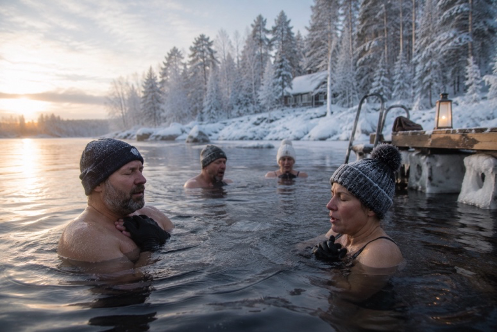 |  |
Left, winter ice bathing. Right, suigyō — cold-water practice in the Tendai Buddhist tradition
People have been stepping into cold water on purpose for a very long time, and doing it every day. In Finland they cut holes in frozen lakes. On Mt. Hiei, the Tendai monks who complete the thousand-day kaihōgyō practise suigyō, cold-water austerity, as part of an ordinary daily routine. Nobody in these traditions knew what the cold was doing inside the body. We can now watch it happen in a single cell.
01 What the Cold Switches On
Cold does not simply make you feel cold. What the swimmers in Finland and the monks on Mt. Hiei were doing, without knowing it, was switching on a tissue called brown fat.
 | • Brown fat burns energy instead of storing it. Newborn babies rely on it to stay warm, because they cannot shiver yet. Adults keep a small amount, mostly around the neck and collarbone. It burns fat and sugar to make heat rather than storing them, and cold is the switch that turns it on. |
 | • Repeat the cold, and your body adapts. In one study, adults spent six hours a day for ten days in a room held at about 15 °C. Their brown fat became more active, and they became better at generating heat without shivering. They also reported that the same room felt warmer than it had on the first day. Their bodies had adapted to the cold rather than simply enduring it. |
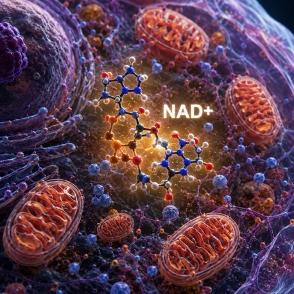 | • All of this runs on one molecule. Every step above — the heat, the burning, the adaptation — spends the same molecule, called NAD⁺. Cold raises the enzyme that produces it. The next section follows that chain from your skin to the inside of a cell. |
02 The Molecule at the Center of It All
NAD⁺ is a molecule your cells spend whenever they repair something, build something, or produce energy. Almost nothing in the body works without it. The diagram below shows the whole route.

Panels 1 to 6: what the cold starts.
1. Cold water on the skin activates brown fat.
2. Inside those brown fat cells, a sensor called AMPK switches on.
3. AMPK responds whenever a cell is working hard and running low on energy.
4. It raises the activity of NAMPT, the enzyme that produces NAD⁺.10,11
5. More NAD⁺ means more mitochondria, and more mitochondria means more ATP.
6. ATP is the energy your body spends on everything from moving a muscle to healing a cut.
The loop at the bottom: how NAD⁺ is recycled. Your cells do not build NAD⁺ from scratch each time they use it. Used NAD⁺ leaves behind a fragment called nicotinamide (NAM). NAMPT turns that fragment into NMN, and NMN becomes NAD⁺ again. NAMPT is the slowest step in the loop, which makes it the bottleneck. Cells make less of it as we age, and the whole loop slows with it. NMN itself is not a foreign substance. Your cells produce it constantly, thousands of times a second. Some NAD⁺ is also spent directly rather than passed on to ATP: the enzymes that repair damaged DNA consume it as they work.
What has been measured in people. In human volunteers, cold exposure raised NAMPT levels in the fat above the collarbone, where adult brown fat sits.
03 What This Means for You
You do not need to be an athlete for this to be relevant. Cold works on systems every body already has.
How Much Cold Each Study Used The research in this article comes from four very different protocols. They are not interchangeable.
The first is the everyday habit this article suggests. The others show what the body can do when the dose is far larger. |
04 Where NMN Comes In
Your cells keep a supply of something called NAD⁺. Picture it as water in a bath. The tap is your body making it. Your cells produce NAD⁺ all day, using an enzyme called NAMPT. The drain is your body using it up. Every repair, every bit of tidying up, every piece of energy your cells produce spends a little NAD⁺. One enzyme, CD38, uses up quite a lot of it. The water level is how much you have available right now. It is never still. Water pours in and drains out at the same time, and the level rests wherever the two balance out. |  | ||
 | As we get older, the balance shifts. The tap slows down. Cells make less NAMPT over the years, so new NAD⁺ arrives more slowly than it used to. At the same time, CD38 becomes busier, so more is drained away. Less coming in, more going out. The level in the bath sits lower than it did when you were younger.
| ||
Cold turns the tap up. This is what the diagram earlier in this article describes. Cold water on your skin sets off a chain inside your cells that ends with more NAD⁺ being made. The drain has not changed. CD38 is still doing what it does. But more water is now coming in, so the level rises.
|  | ||
 | NMN adds water from outside. The tap is not the only way to fill a bath. NMN is one of the materials your cells use to make NAD⁺, and taking it adds to the same supply from outside the body. That NMN raises NAD⁺ in people is well established.¹²,¹³ | ||
Two ways to keep the level up. Nobody has yet measured what happens when you do both, and that is the study we would most like to see.
05 How to Start
THIS IS NOT A PRESCRIPTION. IT IS A PLACE TO BEGIN.
1. Start small. Finish your normal shower with 15 to 30 seconds of cold water, a few days a week.
2. Build up to 30 to 90 seconds daily over several weeks. In the shower trial, thirty seconds worked as well as ninety.7
3. Use your own comfort as the measure. In the acclimation studies, the clearest sign of adaptation was that the same cold began to feel easier. If week four feels easier than week one, your body has changed.
4. Do not aim for completely comfortable. The goal is to shiver less over time, because brown fat takes over the work. But the cold has to be real enough to prompt that change. In the study where nobody shivered at all, insulin sensitivity did not improve. This is not a reason to push into pain.4,5
5. If you train with weights, keep cold water away from the hours right after your session. Use it on recovery days.
6. If you take NMN, take it steadily every day, as ongoing support for the same pathway. It is not something that improves a single cold shower.
7. Give it weeks, not days. Every human study that produced a measurable change ran for at least ten days of repeated exposure.
None of this requires a cold plunge tank or a wetsuit. It asks for thirty extra seconds at the end of a shower you were already going to take. In return, your cells get a small daily push toward the way they were built to work. For a body that quietly repairs itself every day, that is a reasonable trade.
· Each volume in our series reviews published human and animal research on one topic.
· Every claim below is referenced, and the full source list appears at the end.
References
van der Lans AAJJ, Hoeks J, Brans B, et al. Cold acclimation recruits human brown fat and increases nonshivering thermogenesis. J Clin Invest. 2013;123(8):3395–3403.
Yamaguchi S, Franczyk MP, Chondronikola M, et al. Adipose tissue NAD+ biosynthesis is required for regulating adaptive thermogenesis and whole-body energy homeostasis in mice. Proc Natl Acad Sci U S A. 2019;116(47):23822–23828.
Hanssen MJW, Hoeks J, Brans B, et al. Short-term cold acclimation improves insulin sensitivity in patients with type 2 diabetes mellitus. Nat Med. 2015;21(8):863–865.
Remie CME, Moonen MPB, Roumans KHM, et al. Metabolic responses to mild cold acclimation in type 2 diabetes patients. Nat Commun. 2021;12:1516.
Sellers AJ, van Beek SMM, et al. Cold acclimation with shivering improves metabolic health in adults with overweight or obesity. Nat Metab. 2024. doi:10.1038/s42255-024-01172-y
Yankouskaya A, Williamson R, Stacey C, Totman JJ, Massey H. Short-term head-out whole-body cold-water immersion facilitates positive affect and increases interaction between large-scale brain networks. Biology (Basel). 2023;12(2):211.
Buijze GA, Sierevelt IN, van der Heijden BCJM, Dijkgraaf MG, Frings-Dresen MHW. The effect of cold showering on health and work: a randomized controlled trial. PLOS ONE. 2016;11(9):e0161749.
Roberts LA, Raastad T, Markworth JF, et al. Post-exercise cold water immersion attenuates acute anabolic signalling and long-term adaptations in muscle to strength training. J Physiol. 2015;593(18):4285–4301.
Piñero A, et al. Throwing cold water on muscle growth: a systematic review with meta-analysis of the effects of post-exercise cold water immersion on resistance training-induced hypertrophy. Eur J Sport Sci. 2024.
Cantó C, Gerhart-Hines Z, Feige JN, et al. AMPK regulates energy expenditure by modulating NAD+ metabolism and SIRT1 activity. Nature. 2009;458(7241):1056–1060.
Jäger S, Handschin C, St-Pierre J, Spiegelman BM. AMP-activated protein kinase (AMPK) action in skeletal muscle via direct phosphorylation of PGC-1α. Proc Natl Acad Sci U S A. 2007;104(29):12017–12022.
Yamaguchi S, Irie J, Mitsuishi M, et al. Safety and efficacy of long-term nicotinamide mononucleotide supplementation on metabolism, sleep, and NAD+ biosynthesis in healthy, middle-aged Japanese men. Endocr J. 2024;71(2):153–169.
NAD+ precursor supplementation in human ageing: clinical evidence and challenges. Nat Metab. 2025;7:1974–1990.
TA MEDICAL · NAD+ RESEARCH SERIES · VOL. 04 OF 12


