The Body's Own Repair Crew: How Cells Share Their Power to Heal
Updated: Jul 24
New stem-cell research shows how the body repairs poor circulation by having healthy cells donate their own energy source to injured tissue — and it points to a specific, reasoned role for NAD+, the molecule NMN is designed to support.
By TA Medical Research Team · 5 min read · Cellular Health
Every cell in your body carries its own tiny power plants, called mitochondria. They turn the food you eat and the air you breathe into the energy your body uses for everything you do, including healing.
New research on a serious circulation disease shows something remarkable: healthy cells can donate their own mitochondria to injured cells nearby. Inside that discovery is a detail connected to NAD+, the same molecule NMN is designed to raise. We'll walk through the discovery first, then explain what that NAD+ detail suggests — a reasoned connection we've built from our current understanding of NMN and NAD workings.

01 A Real and Serious Problem: When Circulation Fails
As we get older, or when conditions such as diabetes take hold, the blood vessels in our legs and feet can slowly become narrow and stiff. Doctors call the mild form peripheral artery disease. In its worst form, called critical limb ischemia, an area of tissue stops getting enough blood at all, and patients can face the real possibility of losing part of a limb, even after every standard treatment has been tried. This is the exact condition the study below investigated.

Doctors already have one helpful option for these patients: taking a small sample of the patient's own fat tissue, processing it to obtain a group of natural helper cells, and placing those cells back into the affected leg. These are called adipose-derived regenerative cells, or ADRCs. This approach has been used in clinical practice for over a decade, and patients' blood flow measurably improves as a result. What has remained a mystery is exactly how.

02 A Surprising Discovery, Made in Mice
Researchers at Nagoya University injected ADRCs directly into injured leg tissue in mice with poor circulation, after first labeling the mitochondria inside these cells with a glowing marker. Right where each ADRC landed, it passed its mitochondria into two kinds of neighboring cells: cells that form the walls of nearby blood vessels, and local immune clean-up cells — a type of white blood cell that clears away damaged material, similar to a cleanup crew after a storm. The mitochondria traveled through tiny physical connections that form wherever two cells sit touching each other, and when researchers blocked those connections in the lab, far fewer mitochondria made it across.

• Finding 1 (real mice, real blood flow improvement) matters because it's evidence from a living animal, not just cells in a dish — that's a meaningfully stronger form of evidence.
• Finding 2 (the delivery route itself confirmed) matters because it answers how the mitochondria physically get from one cell to another at all — without it, the whole “donation” idea would just be an unexplained observation.
THE CORE FINDING The ADRCs were physically giving away their own working mitochondria — not simply sending chemical signals, as scientists had long assumed. |
03 What Happens Once the Delivery Arrives
To understand why this donation mattered, it helps to know how new blood vessels normally form — a process common to all healing, not unique to this study. Oxygen-starved cells release a chemical signal that spreads outward, and nearby healthy vessels sense it and grow new branches toward the source, branching a bit like roots underground, but reaching out to help another area to provide the needed oxygen and nutrient supplies. This is called angiogenesis, and it's well-established general biology, not something unique to this study.
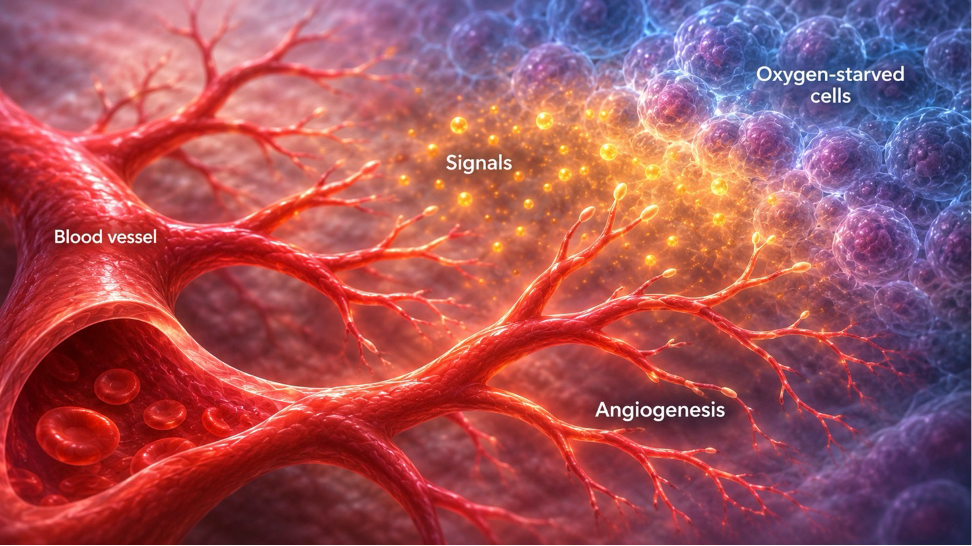
Here is what the Nagoya study actually showed. Scientists already knew ADRCs help repair tissue by releasing growth-promoting molecules and reducing inflammation.
This study revealed another layer: throughout the injured area, ADRCs repeatedly donated working mitochondria to nearby vessel cells and immune clean-up cells, helping these cells build new blood vessels and repair the surrounding tissue.
Live mice showed this directly. When researchers severed the pathway that normally carries mitochondria from the ADRC cells to their neighbors, new blood vessel branches barely formed at all — a striking contrast to how prolifically new branches grew when that pathway was left intact. This confirmed that the mitochondria hand-off itself, not just ADRC's already-known effects, was driving the vessel-building.
Cells deprived of oxygen and nutrients weaken very quickly — with every passing moment before help arrives, they move closer to permanent damage, much like someone stranded in open water. This is exactly why speed matters so much in this kind of rescue. ADRCs are injected directly into the injured muscle itself, and the mitochondria hand-off happens right there — reaching whatever vessel cells already exist at that exact site within hours, rather than needing any signal to travel in from elsewhere. The mouse experiments captured that urgency in real numbers: treated animals already showed significantly better blood flow within the first week, with that advantage continuing to grow over the following three weeks.
“Mitochondrial transfer is a potential mechanism for therapeutic angiogenesis with these stem cells.” — Angiogenesis, 2025 |
04 Where NAD+ Fits In
Remember, the donated mitochondria described above went to two specific places: the vessel-lining cells that build new blood vessels, and the immune clean-up cells (white blood cells) that calm inflammation. Both of these jobs take energy, and that's where NAD+ comes in.
NAD+ is the fuel that powers mitochondria, the same way gas powers a car engine. Without fuel, an engine cannot run — and building a new mitochondrion works the same way, requiring fuel of its own. This is the extra energy the vessel cells needed to grow new branches into the injured area.
Two things are happening together here, on two different timelines. Mitochondria donation happens immediately, everywhere ADRCs are injected throughout the injured area, since it depends only on direct cell contact, not on blood flow — this part is directly confirmed by the study itself. NAD+ support likely follows a different, slower timeline: at first, it would mainly reach branches growing in from healthy, well-perfused vessels at the edge of the injury, since that's where reliable blood flow already exists. As those branches extend inward and connect with newly forming vessel segments, blood — and the NAD+ it carries — would gradually reach deeper into the reconstructed network over time. This second part is our own reasoned extension of how vessel networks generally mature, not something this study specifically measured.

Human studies show that oral NMN reliably raises NAD+ in the blood and inside immune cells — the same white blood cells described earlier — but not inside muscle tissue, likely because muscle sits deep inside the body while immune cells travel directly in the bloodstream. Vessel-lining cells are, if anything, even more exposed to blood than immune cells: unlike white blood cells, they never leave their post, forming the inner surface of every vessel and staying in constant contact with it.
Based on that, our reasoned view is that NMN's proven NAD+ boost in the blood most likely reaches vessel-lining cells too, the same way it reaches immune cells, since both sit in direct contact with blood the way muscle does not. This has not been tested in this exact context, so it remains our reasoned expectation rather than a confirmed result — but it is a specific, evidence-based expectation, not a guess, and it is the reason this detail earns a place in this article.
05 Why This Matters, Even If You Don't Have This Condition
Although this research investigated a severe circulation disorder, the underlying biology is something every one of us depends on every day. Your body is constantly repairing and renewing itself — after exercise, healing a small cut, maintaining healthy skin, and replacing worn-out cells throughout the body. All of these everyday jobs depend on healthy mitochondria, and healthy mitochondria depend on NAD+, a molecule known to decline with age. Human studies have already shown that oral NMN reliably increases NAD+ levels in the body. While NMN itself was not tested in this study, the findings provide a biologically reasoned explanation for why maintaining healthy NAD+ levels may help support your body's natural ability to repair, renew, and maintain itself as you grow older.
Fortunately, most people will never develop critical limb ischemia. Yet the foods we choose over many years can gradually shape the health of our blood vessels, influencing how well they continue delivering oxygen and nutrients to every tissue in our bodies throughout life.

About this research: This article is based on a peer-reviewed study published in the journal Angiogenesis (2025) by researchers Yiyang Che, Yuuki Shimizu, and colleagues at Nagoya University Graduate School of Medicine, Japan. The findings described were observed in a mouse model of poor circulation and in laboratory cell cultures, and have not yet been confirmed in human patients. The connection to NAD+ and NMN is our own reasoned interpretation, based on separate research into NAD+ and NMN — it is not a finding of this study, and NMN was not tested here. |
Reference
Che Y, Shimizu Y, Hayashi T, Suzuki J, Pu Z, Tsuzuki K, Narita S, Yura Y, Shibata R, Murohara T. Mitochondrial transfer from adipose-derived regenerative cells contributes therapeutic angiogenesis in a murine hindlimb ischemia model.
Angiogenesis. 2025;28(4). PMID: 40928669.
TA MEDICAL · CELLULAR HEALTH RESEARCH SERIES